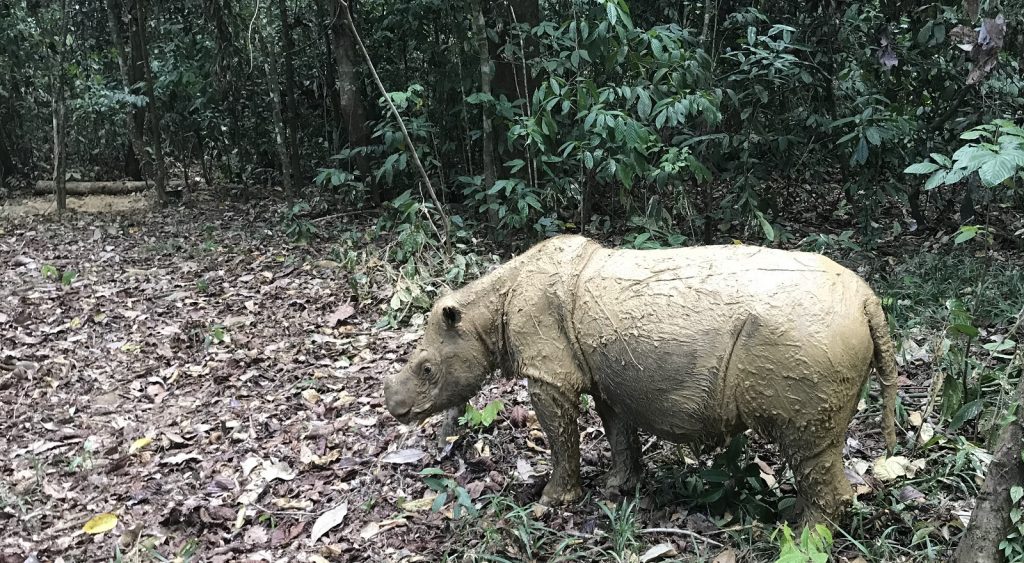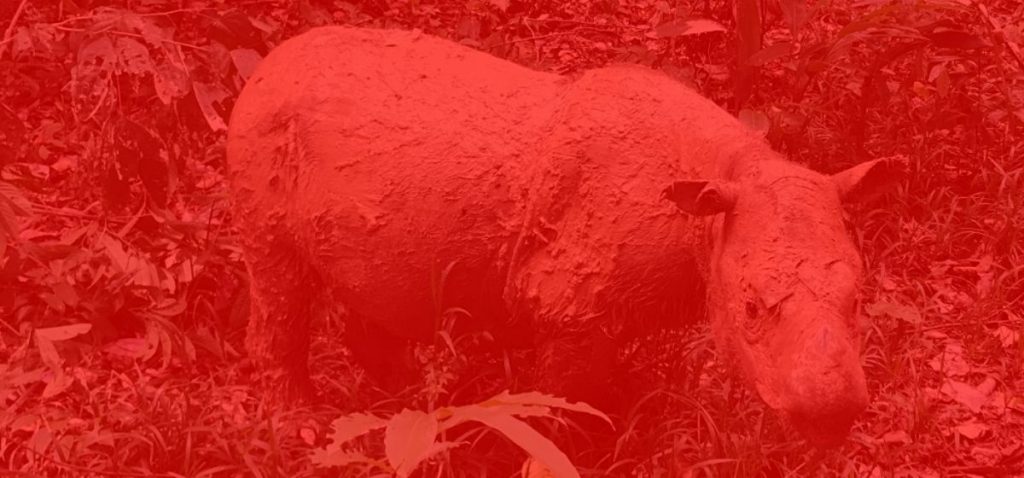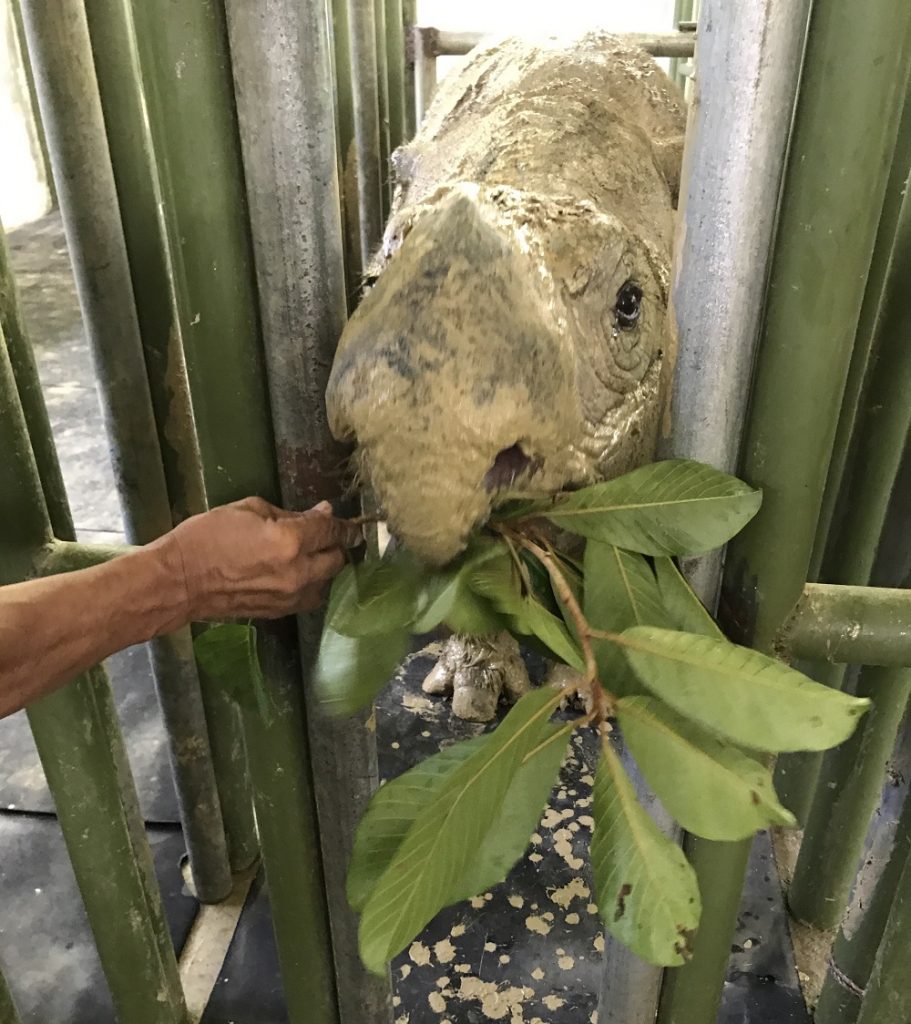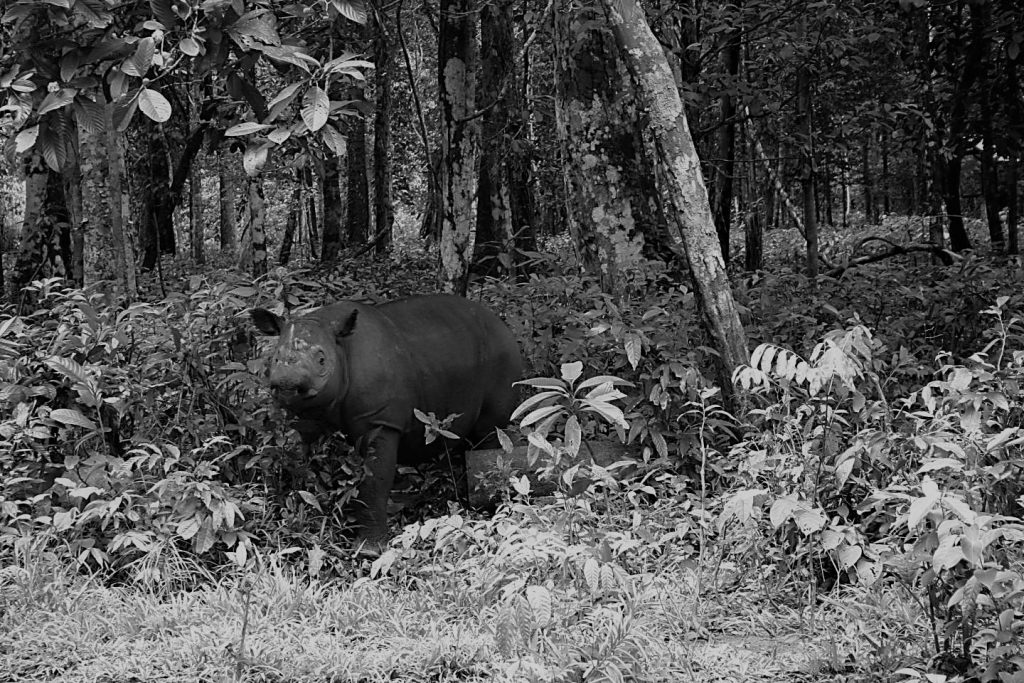
Some photos of the exciting capture and translocation of Puntung the isolated female rhino to sanctuary where it is hoped she will find a ready mate. Click on a picture to view.
BORA is an NGO which is dedicated to uniting partners in a concerted campaign to save Borneo's Sumatran Rhino from extinction.
Some photos of the exciting capture and translocation of Puntung the isolated female rhino to sanctuary where it is hoped she will find a ready mate. Click on a picture to view.
It is hailed as a Christmas miracle which spells hope of survival for the almost extinct Borneo Sumatran rhinoceros. After three years of searching, the Sabah Wildlife Department and the Borneo Rhino Alliance (BORA) have announced that they have captured a young female one in the Sabah rainforest. Named “Puntung”, she is between 20 and 30 years old. And she has been airlifted into a forest enclosure of 20 hectares in the Tabin Wildlife Forest Reserve where she is expected to mate with Tam, a 20-year-old rhino which was rescued in 2008 while wandering in an oil palm estate.
“It is an ideal age for breeding,” says Junaidi Payne, executive director of BORA. But previous attempts in the 1980s and 90s to breed Borneo Sumatran rhinos in captivity failed. Payne is “cautiously optimistic” that this time it might succeed.
He notes that they don’t seem to mate in the wild. “We have monitored her since 2007 and there is no sign that any other rhino has entered her range in the past five years,” Payne says.
Nobody knows how many Borneo Sumatran rhinos remain; but wildlife officials say there may be less than 40 of them. – Insight Sabah (29 Dec 2011).
New Straits Times, column, Nov 20 2011
Not long after news last month of the extinction of the Javan rhino on mainland Asia last year, the extinction of the western black rhino in Africa was announced on Nov 11.
In that most recent announcement, International Union for Conservation of Nature (IUCN) experts noted that the next rhino likely to go extinct is the northern white rhino, a central African subspecies of white rhino.
How is this relevant to Malaysia? The last Javan rhino in Peninsular Malaysia was shot in 1932. Since the 1930s, Malaysia’s most endangered wildlife species has been the Sumatran rhino. The Sumatran rhino still survives in Malaysia, but is now close to extinction.
In 1984, an international meeting of Sumatran rhino experts was convened in Singapore under the aegis of IUCN, and an agreement was forged for collaboration between the governments of Peninsular Malaysia, Sabah, Indonesia and a number of overseas zoos to work to prevent the extinction of this species
The agreement involved the establishment of protected areas that still contained small wild rhino populations, and a programme of captive breeding, involving rhinos to be taken from areas which at that time were under forest but allocated for conversion to plantations.
In several ways, the plans worked out. In the 1980s, Sabah established the Tabin Wildlife Reserve and Danum Valley conservation area, while Indonesia set up national parks in areas containing Sumatran rhinos.
The New Straits Times editorial of Sept 11, 1985 entitled “A survival kit for the rhino” gave a remarkably pragmatic and balanced opinion of the plan, stating that “in matters of conservation, there is little room for parochial attitudes and meaningless slogans about national heritage. Malaysia holds in trust for the whole world some of the rarest and most interesting wildlife.
Malaysia cannot take the risk of unwittingly allowing it to have the dubious distinction of being known as the last place on earth where the Sumatran rhino roamed”.
Unfortunately, that sentiment went unheeded. A number of Malaysian non-governmental organisations slammed the captive breeding component, mainly over the fear that our rhinos might end up in the United States, and the Sabah government withdrew from the agreement. Peninsular Malaysia and Indonesia enjoyed some collaboration but in many respects charted their own courses for the rhinos.
A total of 40 Sumatran rhinos were captured between 1984 and 1994 in Sumatra, Peninsular Malaysia and Sabah. The upshot, however, was that of 18 rhinos caught in Indonesia, only one pair bred, producing three babies in Cincinnati Zoo, the oldest of which has been returned to Indonesia and is now the only breeding male in the Sumatran Rhino Sanctuary in Lampung province.
Even though nine females and three males were caught in Peninsular Malaysia and eight males and two females in Sabah, there was no transfer of rhinos between the two regions, and none bred.
Of those 20 Malaysian rhinos, only one survives today, a female which is now too old to be able to breed, although she was fertile when captured in 1994. For wild Sumatran rhinos, it is now four years since the last evidence of a birth in Malaysia
The fact that the Sumatran rhino is not already extinct can be viewed as luck or a miracle.
A last-ditch effort to save the species, the Borneo Rhino Sanctuary programme, is under way in Sabah, a government programme implemented by the Sabah Wildlife Department with support from the Leibniz Institute for Zoo and Wildlife Research (for rhino reproduction), Borneo Rhino Alliance (operational) and Yayasan Sime Darby and World Wildlife Fund (financial)
What lessons may we draw from the tale of the continuing decline of the Sumatran rhino? The first is we are now well beyond the “usual suspects” of habitat loss, poaching and lack of awareness as the main threats. The problem now is that most remaining rhinos are old or infertile, and too few and too scattered to meet and breed.
The second is that once a species declines to such very low numbers, the only way to boost numbers and birth rate above death rate may be to bring some individuals into semi-natural fenced conditions. The idea is to maximise the prospect of every individual rhino to contribute to the species’ survival.
Catching rare wild animals to breed them in captive conditions with the involvement of non-governmental organisations tends to be a “politically incorrect” concept nowadays. Yet, that is exactly how and why the African and Indian rhinos did not go extinct in the late 19th and early 20th centuries. This was also one of the main reasons for the establishment of the World Wildlife Fund in 1961.
Thirdly, the lack of success of the 1984 IUCN-brokered collaboration agreement to save the species went off the rails largely because of a lack of close collaboration between all the parties involved.
So, the third lesson is: the need for open and whole-hearted collaboration, collaboration and collaboration, so that all parties are armed with all the latest information and thinking, so as to be able to choose the best way forward through the maze of opinions, partial information, assumptions, egos and government policies.
This time, a generation after a most sensible public statement was published in the NST on how to save the Sumatran rhino, let’s get it right. Otherwise, Malaysia will be able to announce the extinction of the species in just another generation from now.
Read more: Last ditch bid to save the rhinos – Columnist – New Straits Times http://www.nst.com.my/opinion/columnist/last-ditch-bid-to-save-the-rhinos-1.8370#ixzz1eG2F6JSJ
The recent news of the extinction of the Javan rhinoceros on mainland Asia, with the death by poaching of the last remaining female in Vietnam in 2010, prompts us to draw attention to two implications for Malaysia. Firstly, this same kind of rhino went extinct in Malaysia in the 1930s. Thus, what seems at first to be only a local loss from Peninsular Malaysia has transformed into a global extinction of a unique population of Javan rhinoceros. It is now up to Indonesia to save the last remaining population of the species, on the island of Java. Secondly, there is another species of Asian rhinoceros of concern nearer to home. This is also an extremely endangered species, commonly known as the Sumatran rhinoceros, previously widespread in Asia but now confirmed to occur only in Indonesia and Malaysia.
Despite dedicated efforts to protect this species from poaching over the past few decades, within protected areas in Sumatra, Peninsular Malaysia and Sabah, numbers have continued to decline. Most specialists close to the situation now believe that habitat loss and poaching no longer represent the major threats to the survival of this rhino. Instead, numbers are so very low that factors associated with low numbers, including inability to find a fertile mate, pathology of the reproductive organs in females resulting in no pregnancies, inbreeding and skewed sex ratio, mean that for many years, rhino death rate has been exceeding birth rate. If this is so, then protection of the remaining wild rhinos and their habitat are necessary but insufficient measures to prevent the species extinction.
In a paper titled “Now or never: what will it take to save the Sumatran rhinoceros Dicerorhinus sumatrensis from extinction?” published in the international conservation journal Oryx earlier in 2011, Ahmad Zafir and his colleagues in WWF-Malaysia, Sabah Wildlife Department and Yayasan Badak Indonesia, wrote the following: “Recent data from governments, NGOs and researchers indicate that the global Sumatran rhino population could be as low as 216, a decline from about 320 estimated in 1995. Based on lessons learnt and expert opinions we call on decision makers involved in Sumatran rhino conservation to focus on a two-pronged approach for conservation of the species: (1) the translocation of wild rhinos from existing small, isolated or threatened forest patches into semi-in situ captive breeding programmes, and (2) a concomitant enhancement of protection and monitoring capacities in priority areas that have established these breeding facilities or have recorded relatively high population estimates and track encounter rates. At least USD 1.2 million is required to implement this two-pronged strategy annually in four priority areas: Bukit Barisan Selatan and Way Kambas National Parks on Sumatra, and Danum Valley Conservation Area and Tabin Wildlife Reserve on Sabah.” The Borneo Rhino Sanctuary programme is already underway in Sabah, based on those two approaches, and implemented by Sabah Wildlife Department with assistance from other agencies including Institute for Zoo and Wildlife Research (Berlin), Yayasan Sime Darby, WWF-Malaysia and Borneo Rhino Alliance, a recently established Malaysian NGO dedicated to saving the rhinos in Sabah. A similar programme has been underway in Indonesia for more than a decade.
The extinction of the Vietnam rhino suggests that leaving rhinos in the wild to be poached or die of old age is no longer an adequate approach. Instead, the Indonesian and Malaysian approach for the Sumatran rhinoceros is most likely now the only way forward to prevent the extinction of this species. Why bother to save the species? The argument is ethical, not economic. Fossils show that something very similar to this form of rhino has existed for about 20 million years, and we may be only a decade or two away from its extinction if no active interventions are made. Now that we know the situation, we ought to try to prevent extinction before that opportunity is lost. Is it worth the money? Ahmad Zafir and colleagues put that question in context, noting in their paper that the annual cost of running the ongoing programmes in Sumatra and Sabah is equivalent to the amount paid at an auction in USA in 2010 for a 1939 edition of a Batman comic book.
We surely do not want Malaysia to have to announce in a couple of decades from now news similar to that from Vietnam last month. Let’s recognise that efforts to promote the survival of the Sumatran rhinoceros ought to be made a national conservation priority.
This joint statement is signed off by the following organisations:
Borneo Rhino Alliance (BORA)
Land Empowerment Animals People (LEAP)
Resources Stewardship Consultants Sdn. Bhd. (RESCU)
Malaysian Nature Society (MNS)
TRAFFIC Southeast Asia
WWF-Malaysia
-Abdul Wahab Ahmad Zafir, Junaidi Payne, Azlan Mohamed, Ching Fong Lau, Dionysius Shankar Kumar Sharma, Raymond Alfred, Amirtharaj Christy Williams, Senthival Nathan, Widodos Ramono and Gopalasamy Reuben Clements.
Copyright notice: Cambridge University Press
Read the full article.
We’re sure many of you know that one of the world’s most magnificent and docile creatures, the Sumatran Rhinoceros (Dicerorhinus sumatrensis), is in deep trouble.
But just how bad is it? From a population of around 320 estimated in 1995, experts now say it could be down to as low as 216 individuals.
One of Rimba’s researchers, Reuben, was involved in a review published recently in the international journal Oryx. This paper was led by Ahmad Zafir Abdul Wahab (currently doing his PhD based at Universiti Sains Malaysia; ahmad.zafir@gmail.com) to find out what needs to be done to save this species from extinction. The consensus is that:
1) Wild individuals have to be captured and put in carefully managed forests that are as large and natural as possible.
2) There has to be an urgent injection of government and private funding to improve protection and monitoring capacities of agencies working on rhino conservation in four priority areas: Bukit Barisan Selatan and Way Kambas National Parks in Sumatra, and Danum Valley Conservation Area and Tabin Wildlife Reserve in Sabah.
Once this basic level of funding is secured for these priority areas, more funds need to be channeled towards a search party to determine the status of rhinos in two other important areas, Gunung Leuser in Sumatra and Taman Negara in Peninsular Malaysia.
Just how much are we talking about for this basic level of funding? Only USD1.2 million! Pocket change for some people, especially the guy who bought a 1939 Batman comic for the same price at an auction in Dallas, back in February 2010.
Surely the price of the Sumatran rhino’s existence is worth much more than a comic book? Surely governments and noble companies can put together a fraction of their GDPs and annual revenues to save this species?
Although the Sumatran rhino has a negative SAFE index of -1.36 and is tipping over into the chasm of extinction, there have been positive historical examples of rebounding rhino populations:
In southern Africa, white rhinos (Ceratotherium simum) rebounded from just 20-50 individuals in the early 1900s to around 17,480 individuals today.
In India and Nepal, Indian rhinos (Rhinoceros unicornis) rebounded from only 200 individuals at the turn of the 20th century to around 2,575 individuals today.
Recovering from 216 individuals is by no means easy in this day and age, but history has shown it’s possible.
Please contact organizations actively engaged in Sumatran rhino conservation like the Borneo Rhino Alliance or International Rhino Foundation if you want to help preserve the existence of the Sumatran rhino. It’s now or never…
Full citation: Ahmad Zafir, A. W., Azlan, M., Lau, C. F., Sharma, D. S. K., Payne, J., Alfred, R., Williams, A. C., Nathan, S., Ramono, W. S., and Clements, R.G. 2011. Now or never: what will it take to save the Sumatran rhinoceros (Dicerorhinus sumatrensis) from extinction? ORYX 45: 225-233.
Face-to-face with what may be the last of the world’s smallest rhino, the Bornean rhinoceros.
Nothing can really prepare a person for coming face-to-face with what may be the last of a species.
I had known for a week that I would be fortunate enough to meet Tam. I’d heard stories of his gentle demeanor, discussed his current situation with experts, and read everything I could find about this surprising individual. But still, walking up to the pen where Tam stood contentedly pulling leaves from the hands of a local ranger, hearing him snort and whistle, watching as he rattled the bars with his blunted horn, I felt like I was walking into a place I wasn’t meant to be. As though I was treading on his, Tam’s space: entering into a cool deep forest where mud wallows and shadows still linger. This was Tam’s world, or at least it should be.
A living—still surviving—Bornean rhinoceros, Tam is only one of an estimated forty left in the world, maybe less. At 620 kilograms (1430 pounds), Tam is a full grown male rhino. Researchers have estimated his age to be about twenty with at least another decade before him. Surprisingly pinkish in color, he is sparsely covered by large black hairs, while both of his two horns—unlike other Asian rhinos who only sport one—have been rubbed dull against the walls of his pen.
Tam is a survivor—that is certain. He survived his forest habitat being whittled into smaller and smaller pockets. He survived his right foot being caught in a poacher’s snare leaving an inch-wide white scar circling his ankle. And he had survived when he wandered directly into an oil palm plantation in early August of last year, probably propelled by his injury. He had beaten the odds, this one.
Everything has changed for Tam now. Cynthia Ong, Director of Land Empowerment Animals and People (LEAP) which has worked on raising funds to save the Bornean rhino, said that since wandering into a plantation over a year ago Tam had become “very manja”. Not being Malaysian I didn’t know the word, but she assured me every Malaysian mother’s daughter knew it, and it meant something like ‘lovingly spoiled’.
It’s true that Tam has entered a kind of retirement. Instead of being butchered for his horn—a fate suffered by a female Bornean rhino in 2001—Tam was immediately seen as a symbol of a dying, but not yet dead, species. His surprising arrival on an oil palm plantation brought the government and conservation community of Sabah into action. He now has a 2.5 hectare pen to his own, complete with forest cover and two mud wallows; he is fed a selection of greens gathered every morning and afternoon by rangers with the Sabah Wildlife Department; and he is protected 24-7 by an anti-poaching squad.
Of course, the situation is not perfect, it would be best if Tam could have remained in the wild to live out his life—only this time near other rhinos, instead of the forest patch where he was trapped and alone. But his injured foot had required care and now he is too accustomed to humans to simply be placed back in the wild, because he would likely wander into human habitations again—where he may not be so lucky.
However his appearance on the human stage has given Tam another role to play: a survivor’s role.
Tam—this massive, purplish, very ‘manja’ animal who almost crushed my hand against the bars as I tried to take rapid photos into his pen because he probably thought I was trying to feed him the camera—could be the key to bringing the Bornean rhino back from the brink.
The story of the two-horned Asian rhino
The story of Tam and his kind goes back—way back.
Bornean rhinos are actually a subspecies of the Sumatran rhino, of which there are only an estimated 250 left in the world. Sumatran rhinos—and their Bornean subspecies—are the only rhinos left in the genus, Dicerorhinus. Most researchers believe that the Sumatran rhino is the last living representative of early Miocene rhinos and therefore the oldest rhino species left in the world, one that emerged between 15 and 20 million years ago.
This also makes the Sumatran rhino the closest living relative to the legendary Woolly rhinoceros, which roamed the steppes during the Ice Age. Evidence of their ancient ancestry is seen in the Sumatran rhinos’ thick black strands of hair; the same hair that probably covered the Woolly rhinoceros, only in a far thicker coat.
For millions of years the Sumatran rhino inhabited Southeast Asia, from Borneo to Northeastern India. Living largely solitary lives, they preferred deep tropical forests near muddy and swampy areas. Not known to fight over territory, the Sumatran rhino is actually quite a gentle creature, despite its heavy bulk and huge horns. Considered the most vocal of all the rhinos, it makes a number of surprising noises, including one which has been compared to a whale singing.
After millions of years the rhino’s fate turned. Following the path similar to many lost and threatened species in the region, habitat loss and large-scale hunting drove the rhino into smaller and smaller pockets until it finally reached its current pathetic state. The rhino’s horn is key to understanding the demise of the animal; it fetches hefty prices (upwards of 30,000 US dollars per kilo) on the black market where it is sold as traditional Chinese medicine. Despite decades of anti-poaching measures and laws, the trade is still booming and rhinos across the world are still paying the price. In fact this year has been a particularly bad one for rhinos worldwide: poaching is at a fifteen-year-high and rhino horn by kilo is not worth more than gold.
The Sumatran rhino has already lost one subspecies to extinction—the Northern Sumatran rhino, once prevalent in India, Burma, and Bangladesh—while the remaining two subspecies—the Bornean and the Western Sumatran rhino—hang-on by a thread in Borneo, Sumatra, and peninsular Malaysia.

Oil palm plantation and tropical forests: plantations have fractured forest habitat across Southeast Asia. Photo by: Rhett A. Butler.
On top of all of this Junaidi Payne, chairman of the Borneo Rhinoceros Alliance (BORA) and longtime conservationist with WWF (World Wide Fund for Nature), Malaysia, says that a new and insidious threat faces the species: population collapse.
“In the past, rhinos were threatened by poaching, loss of habitat and so on. But now they are mostly threatened by the simple fact that there just aren’t enough of them around in one place anymore,” Payne told The Star.
Habitat is so fragmented and rhino numbers so low, that many remaining rhinos are simply unable to locate another individual to breed with. They are caught in pockets of forest surrounded by oil palm plantations with no opportunity to safely cross the plantations and reach other rhinos. Tam is an example of this: his front foreleg was caught in a snare that was mostly likely put out by oil palm plantation workers.
“Most workers in oil palm plantations, as well as rural people in general, do not earn big incomes and survive how they can” says Payne. Palm oil plantation workers—mostly immigrants from Indonesia and the Philippines in Sabah—as well as local people in some areas, are known to set snares to catch deer and other animals for meat, but these snares trap indiscriminately and sometimes injure or kill Bornean elephants, sunbears, rhinos, and other imperiled species.
But it’s not just the situation on the ground that has brought the Sumatran rhino so close to extinction; it is also a matter of perception. Both Payne and Ong told me that Tam and his kind have been largely overlooked by the public, both local and international.
“People don’t understand the significance of the rhino,” Ong says, who describes the Sumatran rhino as “one of the top five endangered mammals in the world”. Ong adds that the public simply doesn’t realize how rare the Sumatran rhino is or its evolutionary importance as the last representative of an ancient mammal line.
In Sabah most of the focus is on orangutans with elephants coming a distant second. When compared to the huge amount of information available on orangutans, there are few research papers, books, and no documentary films on Sumatran rhinos. Any conservationist knows that it is difficult to save a species that doesn’t excite the imagination of the public, and since rhinos are so secretive and rare they have largely been out of sight, out of mind.
“It could be an intimate relationship [between humans and rhinos], but how we choose to engage shows us where we are at as a human community,” Ong says.
The good news is that the Sumatran rhino has a new champion. Having worked to save numerous species in Sabah, Payne says that he has now dedicated his time to saving the embattled rhino.
However, his decision raises some eyebrows.
Why work to save a doomed species?
Why? Junaidi Payne gets asked this question all the time. Why work to save a species that is doomed to extinction? Why not work on a species with a little more promise, like, say, the orangutan or elephant?
“Simple reason,” Payne told me. “There are estimated to be 11,000 orangutans [in Sabah alone] and probably 1,500 [Bornean pygmy] elephants, but there are no more than forty rhinos and new populations have stagnated and are going down slowly. It’s about need.”
However, Payne is not shy about the difficulties facing him and others who have joined the new effort to save the Bornean rhino.
“One can guess that there might be only 6-7 fertile females [of Bornean rhinos] in existence,” he says, adding that with this knowledge in hand “anyone, any common sense person, would agree that [attempting to save the subspecies] is a waste of time”.
I asked Payne if he believed then that the rhino was doomed.
“Probably,” he answered. “Yet maybe not”. And it is that ‘maybe not’ that really interests and excites Payne. He remains hopeful—and with good reason.
Payne pointed out to me that past conservation success stories prove the rhino is not a lost cause. At the end of the Nineteenth Century, Africa’s white rhinoceros—once widespread—were down to just over twenty individuals surviving in one location in South Africa. Intensive conservation measures pulled the white rhino back from the brink: today an estimated 17,480 white rhinos live in east and southern Africa, making it the most populous rhino species in the world.
But it’s not just the white rhino: over one thousand European bison survive today, all of which are descended from just a dozen individuals in captivity; and after going extinct in the wild in the 1970s, the Arabian oryx has been successfully reintroduced into its native habitat—several hundred strong—while at least 6,000 survive in captivity.
Despite these and other success stories, Payne says that there has been a “strange change where academics claim [species] are doomed unless you have a certain minimum number of individuals – often the number 500 has been proposed “.
Payne calls this the “geneticist’s tyranny” where in spite of “empirical evidence” that large mammals have gone through genetic bottlenecks and come back, many geneticists would claim that the fate of the rhino is already decided.
“People are forced to give reasons why we save these species,” Ong added, but it’s clear that “you can change the course of events”.
Of course, the question of ‘why?’ could be asked of any endangered animal. Why put money, time, and energy into saving a species at all? Certainly, species provide what are called ‘ecosystem services’, they in concert with their environment, provide pollination, clean water, clean air, food, medicine etc. But are there other reasons?
“I can only say—I’m shy to say it […] but the general answer would be that humans, having even thought about [saving a species], gives some responsibility to actually save them,” Payne said.
Ong agrees that the decision to save a species says just as much about humans as it does about the embattled and vanishing species: “I see this as a question of where we are in our evolution and how do we respond to this critical situation.”
She then puts it in more personal term: “When our great grand children ask ‘when you found out about [the rhino] what did you do?’ How will we respond?”
The plan going forward
Of course, it’s not enough to simply decide to save a species on the precipice of extinction, large-scale action and a lot of funds are required. In the case of Sumatran rhinos, there has already been a concerted effort to save the species—which ended in failure.
The Sumatran rhino is the world’s smallest rhino species, while the Bornean subspecies is smaller than the Western Sumatran. Photo by: Jeremy Hance.
In 1984 the IUCN brought together a wide range of interested parties from Peninsular Malaysia, Sabah, Indonesia, the United States, and Britain to discuss how to save the Sumatran rhino. They decided the best thing would be a globally managed program of captured individuals for breeding in captivity in a number of different locations. Between 1986 to1994, around forty Sumatrans rhinos were caught and placed in zoos, as well as other closely managed situations.
The government of Sabah embraced the plan. In 1988 they established Sabah Wildlife Department, previously a division of the Forestry Department, which was created in part as a means to facilitate rhino conservation.
Unfortunately the well-thought out plan didn’t produce: only one breeding pair was successfully established in Cincinnati Zoo, bearing three offspring. Nearly all the original rhinos caught are now dead; the only female to bear offspring died just this year.
Starting in the late 1990s, another breeding site of 100 hectares was established at Way Kambas on Sumatra. However, while the conservation center includes three females and two males, no offspring have been born. Conservationists hope that will change, since the second male was only brought in two years ago.
“The thinking is that the whole idea of very closely managed rhinos in captivity isn’t working as well or as fast as is needed to save the species,” Payne says.
In 2007 researchers concluded at a Conference on Rhino Conservation in Sabah that due to reproductive issues and possible inbreeding, rhino numbers in the Malaysian state had stagnated and were probably declining, therefore simply preserving habitat for rhinos would not save them, nor they thought would captivity. A bold and innovative proposal was put forth.
As Payne tells it, the conservation community was confronted with a choice: either do nothing or place rhinos in a large conservation area that would be less closely managed.
Two years later Payne and BORA are in the midst of assisting the Sabah Wildlife Department in implementing a vast fenced-in sanctuary—4,500 hectares—where Bornean rhinos can be brought together. The rhinos will be monitored, but will have “minimal human influences”. They will be largely left alone in the hopes that nature will take its course and the rhinos will breed.
“In theory we are putting one half of Sabah’s rhino eggs in one basket,” Payne says of the plan.
Ong adds that conservationists have to “make a decision to go all the way with human intervention or why bother.”
Only rhinos which are cut off from others will be placed in the new sanctuary. Rhinos in parks like Tabin or Danum, which are known to be breeding on their own, will not be a part of the sanctuary, but will be left in the wild and protected by anti-poaching units.
The sanctuary already has its first resident. It is, of course, none other than Tam, who is bidding his time until the new sanctuary is built and the other rhinos are caught and brought in. If all goes according to plan Tam will come face-to-face with a female, perhaps his first ever. Payne says that the sanctuary only needs one more male and two females to make the program “just about doable”.
The plan has received full-support by the government and funds have been promised to the tune of 8 million ringgits by the national government (over 2 million US dollars) and 250,000 ringgits (70,000 US) by the State Ministry of Tourism, Culture and Environment for interim holding paddocks for rhinos. The sanctuary has also received a large donation by the Sime Darby Foundation, a corporate social and environmental responsibility arm of one of Malaysia’s largest palm oil companies. All that needs to happen now is implementation on the ground: basic infrastructure is scheduled to be completed by next year.
“Director of Sabah Forestry Department, Datuk Sam Mannan, and Sabah Minister of Tourism, Culture and Environment, Datuk Masidi Manjun have both taken lead roles in supporting the early stages of the program, and both have shown a strong personal interest in pushing it forward.” said Payne.
Masidi, well-known is Sabah for his unwavering commitment to environmental issues, headlined a fundraiser in the spring organized by LEAP that raised 530,000 ringgits (150,000 US) for BORA. Without such government support, the plan to save the rhinos would have stalled before it even started.
Payne believes that Sabah is the best hope for the Sumatran rhino going forward, despite Indonesia having a larger population of the rhinos.
“Due to human population pressures in Indonesia and the massive expansion of big scale plantations that compete for land with small-holders,” Payne says that “it may be only a matter of time before the Sumatran rhino vanishes from the wild in Indonesia”.
A large number of unanswered questions remain—such as just how many rhinos are left and how many are capable of breeding—but Payne says that the answer to these questions are largely unnecessary for conservation efforts.
“What is the point spending 10 years researching if the population is 10 or 15 individuals when the species is still going down?” he asked.
Conservation, according to Payne, cannot always wait for hard science and data; often it comes down to using one’s “best judgment” at the time to save a species.
When I left Tam the first time, I thought it would be the last. But the next morning, to my surprise, we were able to visit him again. Beforehand we followed rangers with the Sabah Wildlife Department in a pick-up as they cut branches, leaves, and vines for Tam’s breakfast.
By the time we reached Tam, he was already waiting at the gate where they feed him, rubbing his head against the bars. Tam was “like a cat rubbing against you”, Cynthia Ong had told me, and it was true. He would rub his head along the bars like a pet asking for attention. In fact, he had largely rubbed away his magnificent horn. This shouldn’t be seen as a bad thing: without a horn he is of little interest to poachers.
Ong described the day that Tam wandered injured into the palm oil plantation as a “fortuitous and unplanned event”, because “it pushed the idea of [the] proposal” to start a massive rhino sanctuary.
Tam, she told me, “is not an accident”.
After eating his breakfast—carefully measured out on a scale meant for a giant—and having his photo taken a few hundred times, Tam turned and made his way back into the forest. First, he spent a moment wading in the mud and then slowly, but surely, he wandered back into the deep green of Borneo’s jungle. One moment he was there, roaming on the forest’s edge and the next he was gone as if he had never been.
Days before when I asked Junaidi Payne if this was the last chance to save the species, he told me simply: “Yes.”
It’s true that this story will end in one of two ways. In the first Tam and all of his kind will vanish from the dwindled forest, leaving not even their ghosts behind. In this version, he will become another member of those animals painted so nicely in books on extinction: Tam, I imagine, will appear somewhere between the dodo, the thylacine, and the great auk.
In the second version Tam and his kind will continue inhabiting the deep, largely unseen areas of Southeast Asia’s magnificent forests. While this version is dependent on many factors not in our control—factors where previous generations have already failed the rhino—it is our choice now whether or not we give this ending a chance.
I don’t know what we will find when the last page is turned, but having been among the fortunate few to come face-to-face with the two-horned rhino of Asia, I can’t help but dread the day we fail, while simultaneously hoping for the day where I can take my children to meet Tam’s.
____________________________________________________
This article written by Jeremy Hance was originally published on MONGABAY.COM
Mongabay.com seeks to raise interest in and appreciation of wild lands and wildlife, while examining the impact of emerging trends in climate, technology, economics, and finance on conservation and development.
Visit Mongabay to read the original article and others like it.